What 1 hour of downtime actually costs
 | July 27, 2026 | 4 min read |
When your systems go offline, everything slows down at once. Calls stop connecting, transactions fail and the workflows your team relies on grind to a halt. Even a short outage can hit your bottom line within minutes.
For most businesses, downtime is a direct, measurable hit to revenue and productivity. To help put a number on the problem, the team at Ooma dug into the research and created an infographic that breaks down what downtime really costs across industries and company sizes.
The universal baseline cost of an outage
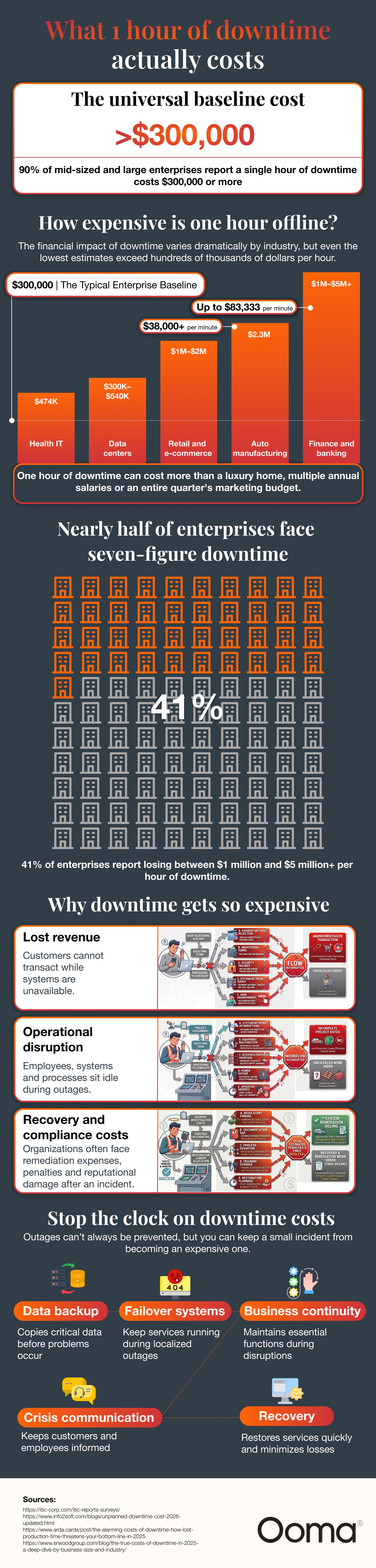
The exact price tag on an outage depends on your company’s size and how complex your operations are, but there’s a baseline worth knowing: Ninety percent of mid-sized and large enterprises report that one hour of downtime costs $300,000 or more.
For a lot of organizations, that’s a very conservative number. For businesses with highly integrated operations, an hour of downtime can cost more than a house, more than a year of multiple salaries combined or an entire quarter’s marketing spend. In fact, 41 percent of enterprises report losing $1 million to $5 million per hour when systems go down.
How the cost of downtime varies by industry
How much an outage hurts usually comes down to one thing: how tightly your network uptime is tied to your revenue and your production line.
- Finance and banking: High-frequency trading and nonstop transaction processing mean costs add up fast here. Losses range from $1 million to more than $5 million per hour, or roughly $83,333 per minute.
- Auto manufacturing: Assembly lines depend on tight synchronization, so when systems go down, so does production. That can run about $2.3 million per hour, or more than $38,000 per minute.
- Retail and e-commerce: If your storefront is offline, customers can’t check out. That’s direct revenue loss, typically $1 million to $2 million per hour.
- Health IT and data centers: Health organizations see costs around $474,000 per hour during downtime, while standard data center outages land between $300,000 and $540,000 per hour.
Why downtime gets so expensive
The cost of an outage rarely stays in one department. It tends to compound across three areas:
- Lost revenue: When your systems are down, customers can’t buy, pay or interact with your business at all.
- Operational disruption: Even when revenue isn’t directly on the line, the bills keep coming. Your team, your systems and your production lines sit idle, which means you’re still paying for labor and overhead with nothing to show for it.
- Recovery and compliance costs: Once you’re back online, the cleanup begins, including remediation work, possible regulatory penalties and reputational damage. In regulated industries, an outage can trigger compliance violations on top of everything else.
Stop the clock: Mitigating the impact of downtime
You can’t prevent every outage, but you can keep a small incident from turning into an expensive one with the right plan in place.
- Data backup: Regularly duplicate critical data in a secondary environment, so you’ve always got a copy ready before hardware fails or a security incident hits.
- Failover systems: A secondary connection that automatically reroutes traffic keeps things running when a server or network goes down locally.
- Business continuity: A solid continuity plan keeps your core operations going even if your primary facility or network is out of commission.
- Crisis communication: Clear status pages, email and text messages keep customers and employees in the loop during a disruption and help preserve their trust.
- Recovery plans: A streamlined recovery protocol gets your services back online faster, which shortens the outage and limits the financial damage.
The ROI of uninterrupted connectivity
The numbers make it clear: Network downtime is a real financial risk. With the cost rising to hundreds of thousands of dollars an hour or more for most enterprises, the real question isn’t whether you can afford to invest in failover solutions: It’s whether you can afford not to. Put business continuity measures and redundant infrastructure in place now and you can protect your revenue, keep customers’ trust and stop a minor hardware glitch from turning into a multimillion-dollar problem.
That’s exactly what Ooma’s business communication solutions are built for: reliable connections that keep your business running no matter what. If you’re ready to see what that looks like for your team, explore our VoIP phone plans and 5G business internet service today.
Frequently asked questions
What is a network failover system?
A failover system is a backup plan that automatically switches your network or communication traffic to a secondary connection the moment your primary connection fails or runs into trouble.
How much downtime is acceptable for a business?
The answer depends on the organization, but many businesses aim for at least 99.9 percent uptime. Even that allows nearly nine hours of downtime per year, which can become costly for organizations that rely on continuous customer access or real-time operations.
What are the most common causes of downtime?
Common causes include internet service outages, hardware failures, software bugs, cyberattacks, power disruptions, human error and third-party service failures. Many outages result from a combination of factors rather than a single event.
Sources:
- https://itic-corp.com/itic-reports-surveys/
- https://www.info2soft.com/blogs/unplanned-downtime-cost-2026-updated.html
- https://www.arda.cards/post/the-alarming-costs-of-downtime-how-lost-production-time-threatens-your-bottom-line-in-2025
- https://www.erwoodgroup.com/blog/the-true-costs-of-downtime-in-2025-a-deep-dive-by-business-size-and-industry/
Husain Sumra is a former journalist who reported on the biggest companies in tech, from Apple to Amazon, covering cloud services, consumer technology and communication solutions. His journalism background has helped him bring a customer-first approach to content marketing, creating pieces of content aimed at helping people.